Wetting Agents: Applications, Benefits, and Industrial Uses Explained
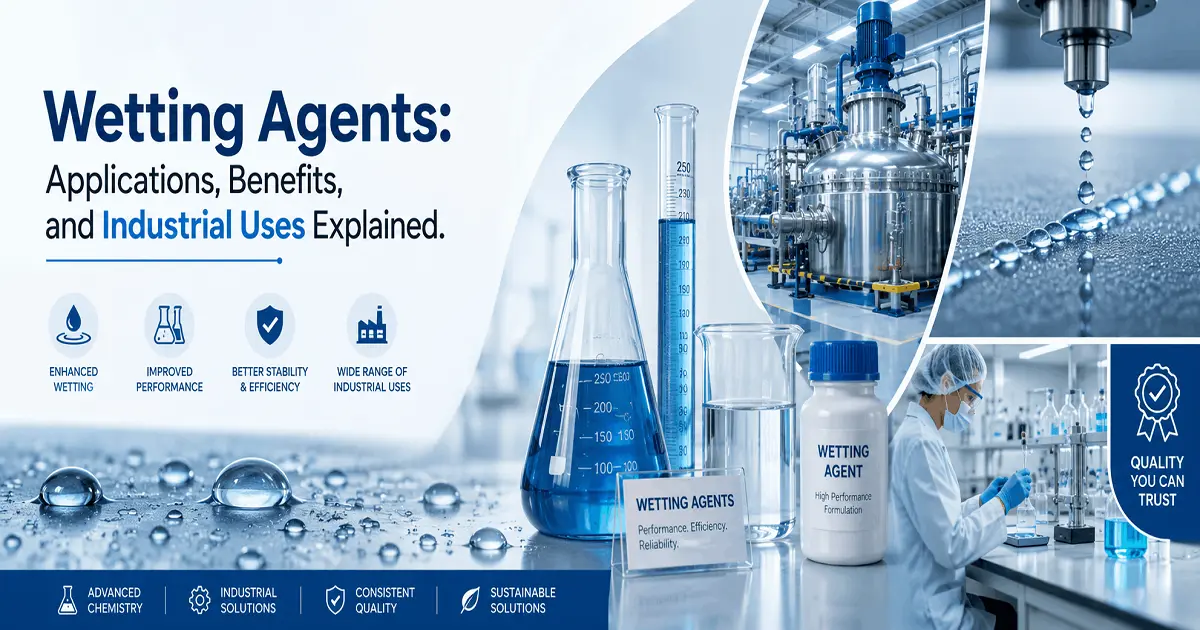
When we talk about industrial processing, achieving uniform liquid spreading across surfaces is very crucial for improving product quality and operational efficiency. You will see several manufacturing sectors, including textiles, paints, agriculture, detergents, and coatings, depend on specialized chemical additives. Among all these additives, wetting agents play a crucial role in improving performance and ensuring consistent application results. The specialty chemicals are designed specifically to reduce surface tension between liquids and solid materials, which allows liquids to spread more evenly. So, without proper wetting action, liquids may fail to coat evenly on the surface, leading to uneven coating problems.
How Does Wetting Action Work?
Water has higher surface tension, which makes it difficult for it to spread uniformly on different types of materials. When a suitable additive is introduced, the surface tension reduces, allowing the liquid to flow more freely on the surface with ease. This process helps to improve the contact between the liquid and the material that is being treated. As a result, manufacturers can achieve better coverage that helps them to improve absorption and product consistency; industries that need precise coating, dyeing, or cleaning processes usually depend on this functionality to maintain production quality. The strength of all these additives actually depends on several other factors, such as composition, the nature of the substrate, and most importantly, the processing conditions. Selecting the right solution helps industries optimize production while minimizing material wastage.
Types of Wetting Agents
Anionic Variants
These are commonly used in detergents, textile manufacturing, and cleaning formulations. These chemicals are known to carry a negative charge, and therefore they provide excellent spreading and foaming properties. Their strong cleaning action makes them suitable for applications where direct removal and surface penetration are extremely important.
Non-Ionic Variants
Non-ionic variants are the wetting agents that do not carry any electrical charge; therefore, they are versatile and stable in various chemical formulations. You will commonly find them in paints, coatings, pesticides, and textile auxiliaries because of their compatibility with different chemical systems.
Cationic Variants
These are the particles that are positively charged, and you can find them in specialized textile softeners, disinfectants, and conditioning products. Their unique charge properties allow them to interact effectively with negatively charged surfaces.
Amphoteric Variants
These solutions can behave as positively or negatively charged; they switch their charge as per the environmental pH . This type of flexibility makes them best suited for products such as industrial cleaning formulations and specialty applications requiring mild yet effective performance.
Industrial Applications Across Multiple Sectors
Textile Industry
In textile processing, it is very important that the dye penetrates and there is uniform chemical distribution. During pre-treatment, dyeing, bleaching, and finishing operations, proper wetting ensures that the chemicals get to the fibers evenly. This results in consistent coloration, improved fabric quality, and reduced processing time.
Paints and Coatings
Proper wetting in paint formulations is essential to get good surface coverage as well as strong adhesion. These additives help coatings spread evenly across surfaces, which prevents defects such as pinholes, streaks, or uneven film formation; they also increase substrate penetration and improve overall coating strength.
Agriculture
The pesticides and fertilizers used for agriculture also need effective surface coverage on plant leaves. The improved spreading guarantees better absorption and distribution, increasing the effectiveness of crop protection products while reducing runoff and wastage.
Cleaning Detergents & Products
Cleaning products heavily depend on the ability to loosen dirt and grease from different surfaces; the increased wetting allows cleaning solutions to penetrate the contaminants deeply and more effectively, improving stain removal and overall cleaning efficiency.
What Are The Key Benefits in Manufacturing Processes?
Improved Surface Coverage
Better liquid spreading makes sure that surfaces are uniformly coated; this reduces defects and improves the overall appearance and performance of finished products.
Faster Penetration
It offers faster penetration into fibers, pores, or rough surfaces, which allows chemical processes to occur more efficiently. This also reduces processing times by giving the best production output.
Reduced Chemical Consumption
Efficient spreading also helps to reduce the amount of formulation needed to achieve the desired result. This helps manufacturers reduce chemical usage and optimize operational costs.
Growing Demand in Modern Industries
As industrial manufacturing becomes increasingly advanced with each passing year, the demand for specialty chemicals continues to rise. Industries are very much looking for good solutions that improve efficiency, reduce waste, and support sustainable manufacturing practices.
Modern formulations these days are being designed for superior performance while meeting stricter environmental and safety standards. Manufacturers are also focusing on performance while meeting stricter environmental and safety standards. Manufacturers are also focusing on creating different products that perform effectively across a huge range of applications.
As India’s trusted Speciality chemical manufacturer, Panacea Chem Specialities is one such name that is committed to delivering high-quality industrial solutions specifically designed uniquely to meet the performance demands of modern industries.
Conclusion
Industrial processing is seen to heavily depend on efficient liquid interaction with surfaces, fibers, and substrates. By improving spreading, penetration, and overall formulation performance, wetting agents contribute significantly to product quality and manufacturing efficiency in different industries. As industries keep evolving toward more efficient and sustainable production methods, the demand for advanced chemical solutions will continue to grow.
Are you looking for high-quality specialty chemicals customized to your industrial needs? Then contact Panacea Chem Specialities to explore innovative formulations designed for high performance across different industrial applications.